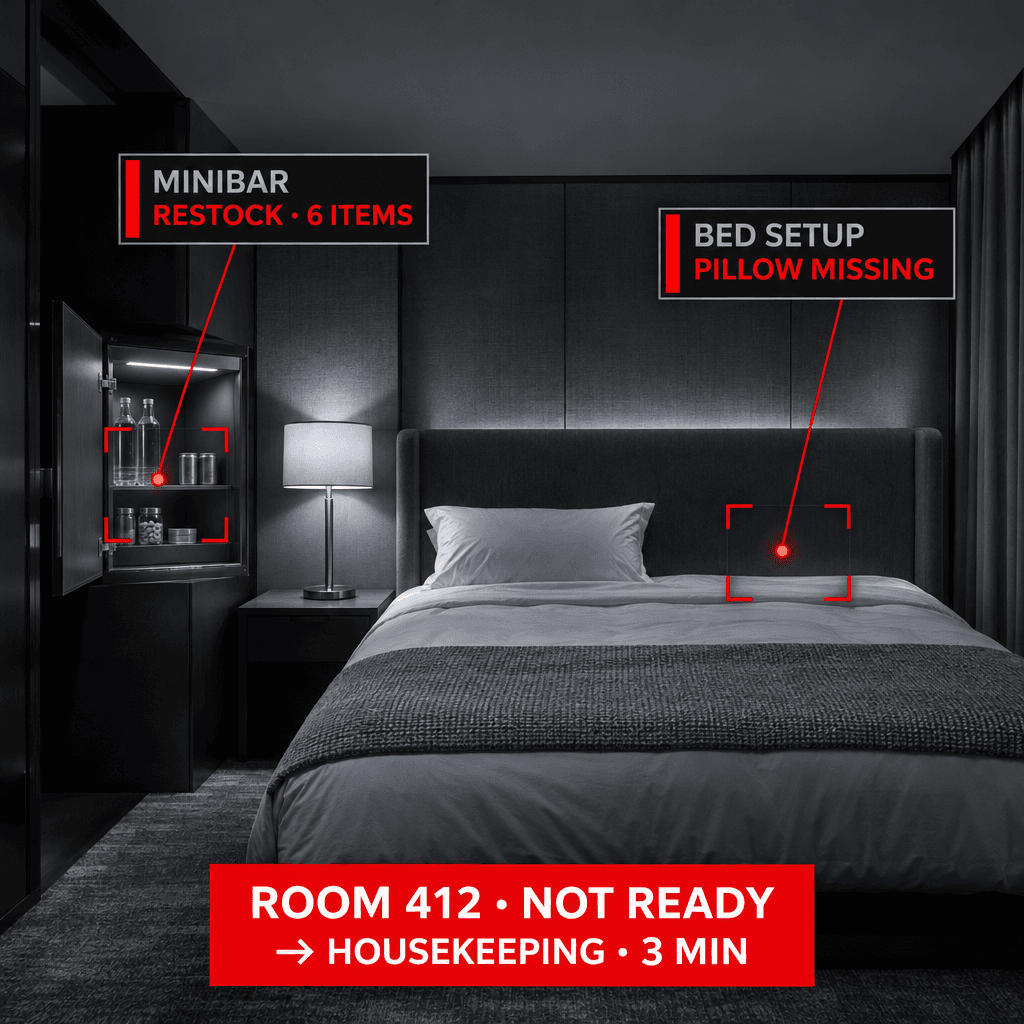
AI CCTV monitoring for hotels: housekeeping and SOP compliance on existing cameras
AI CCTV monitoring for hotels uses the cameras a property already has to check housekeeping, cleanliness, maintenance and SOP compliance continuously, instead of only when a supervisor walks the floor. Video is analysed on site, the system detects operational events such as a spill in the lobby, a room left unready or a leak in a plant room, and each finding becomes a task in the system the team already uses. It does not identify guests or staff. Vigil by CamCom is built for this: it runs on existing IP cameras and is validated on a property in 30 days.
Why spot-check audits miss most problems
Housekeeping and quality audits are periodic. A room is checked when the supervisor inspects it, a corridor when someone walks it, a washroom when it comes up on the rota. Between those checks, sometimes for hours, nobody is looking. Most guest complaints about cleanliness and readiness come from that gap. Adding more inspectors makes audits more frequent but never continuous, and results still depend on who is checking.
Related reading: Hotel housekeeping checklist: what to check in every room
What AI on existing CCTV can check
- Room and public-area readiness. Whether a corridor, lobby or function room has been reset to standard, and whether a room has been serviced before the guest arrives.
- Cleanliness and hygiene. Spills, litter, overflowing bins, unattended trolleys and back-of-house hygiene lapses.
- Maintenance. Leaks, faulty lighting, damaged fittings and readings that drift out of range in plant rooms.
- SOP compliance. Whether a procedure happened at the right time and place, such as a missing wet-floor sign next to a fresh spill.
- Safety hazards. Slip and trip risks, blocked exits and obstructions in public areas.
Each detection carries the camera, location, time and an image, and is routed to the team that owns it. Housekeeping gets the room, engineering gets the leak, public areas gets the spill.
How it works on cameras you already have
- Connect existing cameras. Standard IP cameras and the video management system stay as they are. No new cameras are needed for areas already covered.
- Process on site. Analysis runs on an edge device at the property. Raw video stays local, and only structured findings leave the building.
- Define the rules. Operations teams choose the scenarios, zones and service standards that matter, for example lobby floors checked every 15 minutes.
- Send findings into existing tools. Results go out as structured data over open APIs to work-order and ticketing systems such as Maximo, Infor, Hippo or ServiceNow, to BI tools, or to Teams, email and SMS.
- Review and tune. Supervisors confirm or dismiss findings, and the system is tuned to the property during the first weeks.
Privacy: monitoring operations, not people
Guests, staff and unions will ask what the cameras are looking for. A system built for operations should detect events and conditions, not identities or behaviour. Vigil does not extract personal information or track individuals, supports configurable face masking, outputs no raw video and shares no data with third parties. Its architecture is designed to align with GDPR, India’s DPDP Act, PDPA and CCPA, and CamCom provides documentation for a property’s privacy review. Under GDPR, large-scale monitoring of publicly accessible areas also requires a data protection impact assessment, so plan for one.
How to evaluate a vendor
- Works on your cameras. Test on your actual camera angles, lighting and resolution, not a demo video.
- Operational scope. Many CCTV analytics products do one narrow task, such as people counting or intrusion. Check how many of your scenarios one platform covers.
- Edge or cloud. Decide whether video may leave the property. Edge processing keeps it on site and reduces bandwidth.
- Integration. Findings that do not reach the work-order system become another dashboard nobody watches.
- Measured pilot. Agree two or three priority scenarios and KPIs up front, measure a baseline and decide on results.
- Portfolio scale. For hotel groups and FM providers, check that the same setup scales from one property to many and supports comparisons across sites.
Running a 30-day pilot
Vigil’s validation follows a fixed shape. In the first two weeks the edge device is deployed on the property’s existing feeds and tuned to its environment. By day 14 the system is running on validated accuracy for that site. At day 30 the property gets an impact report against the scenarios and KPIs agreed at the start, and a clear decision on whether to scale. What the property provides: access to the relevant camera feeds, an operations and IT contact, and feedback during the validation.
Related reading: Facility management: what FM teams inspect, and how continuous monitoring changes audits · Vigil: AI monitoring for hotels and facilities
Common questions
Can AI monitor hotel housekeeping using existing CCTV?
Yes. AI video analytics can run on a hotel’s existing IP cameras to check room and public-area readiness, cleanliness and SOP compliance continuously, and send each finding to the housekeeping or engineering team. Areas without cameras, such as guest rooms, still need manual checks.
Do we need new cameras?
Not for areas existing cameras already cover. Vigil works with existing IP cameras and visual feeds and integrates with current work-order and building management systems rather than replacing them.
Is AI CCTV monitoring compliant with privacy law?
It can be, if it detects operational events rather than people. Vigil does not identify individuals, supports face masking, keeps raw video on site and is designed to align with GDPR, DPDP, PDPA and CCPA. Properties in the EU should run a data protection impact assessment before deployment.
What can it detect in a hotel?
Spills and slip hazards, litter and overflowing bins, areas not reset to standard, missing signage, leaks and faulty fittings, and other deviations from the property’s own SOPs.
How long does deployment take?
Vigil is deployed on the edge and validated in 30 days, with the system tuned to the property by day 14 and an impact report at day 30.
Sources: CamCom, Vigil by CamCom: AI monitoring for hotels and facilities (capabilities, privacy design, integrations, 30-day validation). European Union, General Data Protection Regulation, Article 35(3)(c) (impact assessment for large-scale monitoring of publicly accessible areas).